
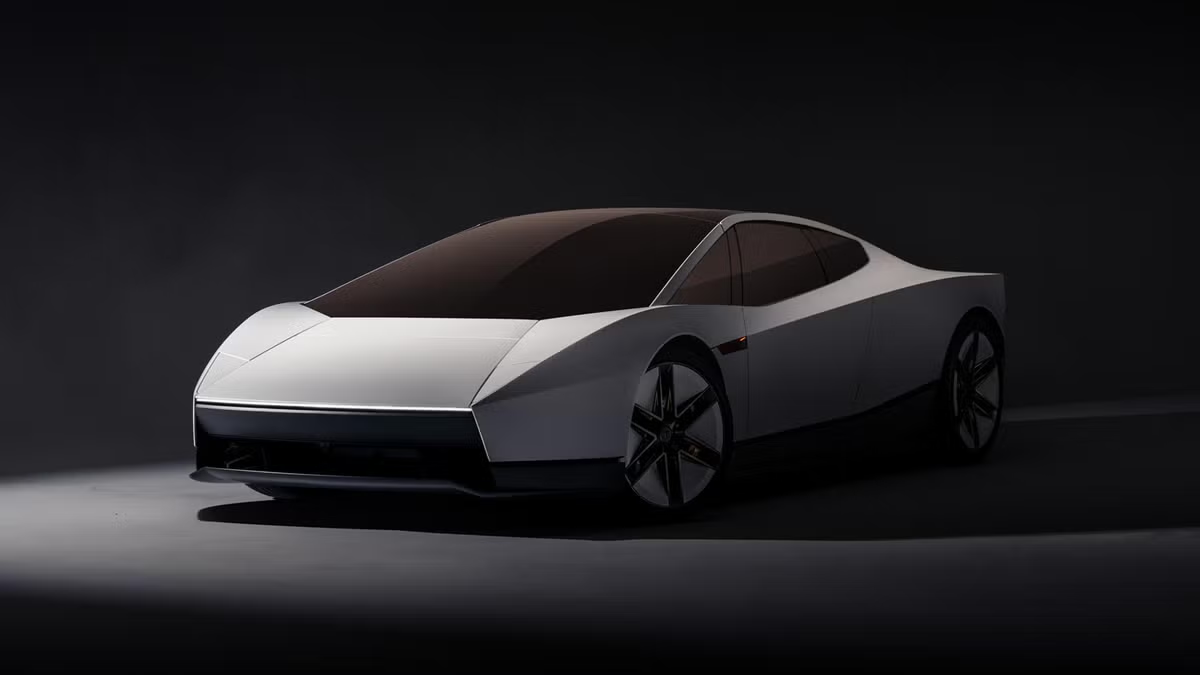
Instead of increasing battery size to extend driving range, what if we focused on building electric cars that consume far less energy—and can even generate their own electricity?
The Problem with Bigger Batteries
How do you increase the range of an electric car? The most obvious solution is to install a larger battery pack. Another approach is to develop batteries with higher energy density, using technologies such as silicon-rich anodes or next-generation cell chemistries.
But there is a third approach that is arguably just as promising: making the vehicle itself dramatically more efficient.
As the electric vehicle market has diversified, manufacturers have introduced everything from compact urban EVs to luxurious long-range electric sedans. At the premium end of the market, vehicles such as the Lucid Air demonstrate just how far battery-electric technology has progressed.
The 2025 Lucid Air Grand Touring, for example, offers an EPA-estimated range of up to 512 miles (824 km). However, achieving this range requires a substantial 117 kWh battery pack.
Lucid has also developed an exceptionally efficient drivetrain, so its impressive range is not simply a consequence of battery size. Nevertheless, the example illustrates an important engineering trade-off: batteries store energy, but they also contribute significant weight to the vehicle.
Additional battery mass increases rolling resistance and the energy required for acceleration and climbing. Consequently, some of the additional stored energy is consumed simply transporting the heavier battery.
Regenerative braking can recover part of the energy used during acceleration and descent, but it cannot eliminate these losses completely.
This raises an interesting question. Instead of continuously increasing battery capacity, what if manufacturers concentrated on reducing the energy needed to travel each kilometre?
A sufficiently efficient vehicle could achieve a respectable driving range with a considerably smaller battery. And reducing battery size would bring additional benefits, including lower weight, reduced material consumption and potentially lower manufacturing costs.
The ultimate expression of this philosophy can already be found in an unusual category of electric vehicles: solar racing cars.
World Solar Challenge: The Blueprint for Extreme Efficiency
For decades, the World Solar Challenge in Australia has demonstrated what becomes possible when energy efficiency is treated as the primary objective of vehicle design.
Held every two years, the competition challenges teams from around the world to travel approximately 3,000 kilometres across the Australian continent, from Darwin to Adelaide, using solar-powered vehicles.
Unlike conventional automotive competitions, where performance is primarily measured by speed, solar racing places enormous emphasis on minimising energy consumption.
The participating vehicles are extraordinary examples of engineering optimisation.
Their structures are frequently constructed using lightweight composite materials. Their bodies are carefully designed to reduce aerodynamic drag. Rolling resistance is minimised through specialised tyres, while electric motors and power electronics are optimised for exceptionally high efficiency.
Some designs achieve drag coefficients well below 0.20, substantially lower than those of most conventional passenger cars.
However, the drag coefficient alone does not tell the complete story. The frontal area of the vehicle is equally important, which explains why many solar racing cars are extremely low and narrow.
These vehicles demonstrate a fundamental principle: when the energy required to move a vehicle is sufficiently low, even the relatively modest amount of electricity generated by onboard solar panels can become a meaningful source of propulsion energy.
There is, however, a major limitation.
Most competition-focused solar vehicles are not particularly practical for everyday transportation. Their cabins are cramped, passenger capacity is limited, ground clearance can be low, and features such as luggage space, comfort and convenience are often sacrificed in pursuit of performance.
Nevertheless, the engineering philosophy behind these machines has inspired attempts to develop practical solar-electric road vehicles.
Aptera: Bringing Solar Racing Philosophy to the Road
One of the most interesting examples is the Aptera, a three-wheeled solar-electric vehicle developed in the United States.
Rather than starting with a conventional passenger car and attempting to improve its efficiency, Aptera adopted an approach that places aerodynamic performance at the centre of the vehicle’s design.
Its distinctive teardrop-shaped body, enclosed two-seat cabin and narrow rear section are all intended to minimise aerodynamic resistance.
The vehicle also incorporates solar cells into its exterior surfaces, allowing it to generate electricity while parked outdoors.
The importance of this arrangement becomes apparent when solar generation is considered alongside vehicle efficiency.
For a conventional EV consuming around 20 kWh per 100 kilometres, generating 2 kWh of electricity would provide approximately 10 kilometres of driving range.
However, for a hyper-efficient vehicle consuming just 10 kWh per 100 kilometres, the same solar energy could provide approximately 20 kilometres.
In other words, improving efficiency effectively doubles the driving distance obtainable from a given amount of solar electricity.
This is one of the most compelling arguments for solar-electric vehicles. Their advantage does not come merely from having solar panels. It comes from combining onboard solar generation with exceptionally low energy consumption.
Aptera has nevertheless experienced significant difficulties bringing its vehicle into commercial production. The company has faced repeated delays, financing requirements and the challenges associated with developing an unconventional vehicle for mass manufacture.
In October 2026, Aptera announced plans to begin building its first 40 production vehicles by the end of the year, with customer deliveries targeted for early 2027, subject to securing the necessary financing.
The project demonstrates both the potential of hyper-efficient automotive engineering and the difficulty of turning an innovative concept into a commercially successful product.
Lightyear: A More Conventional Solar-Electric Car
Another notable attempt came from the Netherlands in the form of the Lightyear 0.
Unlike Aptera, Lightyear pursued a more conventional four-wheel, five-seat passenger car design. Its objective was to combine practical everyday transportation with exceptionally low energy consumption and integrated solar generation.
The vehicle featured a highly aerodynamic body and solar panels distributed across its roof and bonnet.
Lightyear’s approach was particularly interesting because it demonstrated that solar-electric technology did not necessarily require the radical appearance or unconventional packaging of a solar racing vehicle.
The Lightyear 0 programme ultimately encountered financial difficulties and production was discontinued in 2023. However, the solar technology business continued separately, focusing on integrated solar charging systems for the wider automotive industry.
Together, Aptera and Lightyear illustrate two different approaches to the same engineering problem: how to reduce the amount of external electricity required to operate an electric vehicle.
The Engineering Behind a Hyper-Efficient Electric Car
The design of a hyper-efficient electric vehicle can be understood through four major areas of engineering: aerodynamics, weight reduction, rolling resistance and drivetrain efficiency.
1. Aerodynamics: Reducing the Energy Required at Speed
At motorway speeds, aerodynamic resistance is one of the dominant contributors to vehicle energy consumption.
Aerodynamic drag is given by:
[
F_D = \frac{1}{2}\rho C_D A V^2
]
Where:
- (F_D) = aerodynamic drag force
- (\rho) = air density
- (C_D) = drag coefficient
- (A) = vehicle frontal area
- (V) = vehicle velocity
The power required to overcome aerodynamic drag is:
[
P_D = \frac{1}{2}\rho C_D A V^3
]
The important point is that aerodynamic power increases with the cube of velocity.
Doubling the vehicle’s speed increases the aerodynamic power requirement by a factor of eight, assuming other conditions remain unchanged.
This explains why aerodynamic optimisation is especially important for electric vehicles travelling at motorway speeds.
Reducing the drag coefficient is only part of the solution. Reducing frontal area can deliver equally important benefits, which is why many solar racing cars have narrow bodies and extremely low profiles.
A practical hyper-efficient vehicle would ideally combine a streamlined body with a relatively small frontal area, without compromising passenger safety or usability.
2. Lightweight Construction and Smaller Batteries
Weight reduction is another important element.
The rolling resistance of a vehicle can be approximated as:
[
F_{RR} = C_{RR}mg
]
Where (C_{RR}) is the rolling resistance coefficient, (m) is the vehicle mass and (g) is gravitational acceleration.
Reducing vehicle mass decreases rolling resistance as well as the energy required during acceleration and climbing.
Lightweight construction can be achieved through careful structural optimisation, advanced materials and the elimination of unnecessary components.
However, perhaps the most interesting opportunity comes from the battery itself.
A vehicle that consumes less energy per kilometre can meet a given range target using a smaller battery pack. Reducing battery capacity then reduces vehicle mass, which can further decrease energy consumption.
This creates a beneficial engineering cycle: lower energy consumption permits a smaller battery, and the lighter battery contributes to even lower energy consumption.
There are limitations, of course. Lightweight materials can increase manufacturing costs, and vehicle structures must continue to meet crashworthiness and durability requirements.
Nevertheless, optimising the entire vehicle around a smaller battery could potentially deliver substantial savings in mass and material consumption.
3. Low Rolling Resistance
Tyres represent another important source of energy loss.
As a tyre rotates, its structure continuously deforms under the vehicle’s weight. Some of the energy involved in this deformation is dissipated as heat.
Solar racing teams use specialised low-rolling-resistance tyres to minimise these losses.
For production vehicles, tyre optimisation must balance efficiency with traction, braking performance, wet-weather safety, durability and ride comfort.
Even relatively small reductions in rolling resistance can produce measurable improvements in driving range.
4. In-Wheel Motors and Drivetrain Efficiency
Many highly efficient solar racing vehicles have experimented with motors integrated directly into the wheels.
This arrangement can eliminate conventional drivetrain components such as driveshafts and certain reduction gears, potentially reducing mechanical losses and freeing up space inside the vehicle.
However, in-wheel motors introduce their own engineering challenges.
Locating the motor inside the wheel increases unsprung mass, which can affect suspension performance, ride comfort and tyre contact with the road. The motors must also withstand harsh environmental conditions, including vibration, water exposure and road impacts.
Cooling the motors can become more challenging, and packaging constraints may limit the motor’s design.
In fact, Aptera originally intended to use in-wheel motors but subsequently adopted a more conventional drivetrain supplied by Vitesco Technologies for its production vehicle.
This highlights an important distinction between achieving theoretical maximum efficiency and developing a commercially practical vehicle.
In-wheel motors are an interesting option, but they are not essential to the concept of a hyper-efficient electric car. The ultimate objective should be the highest achievable system efficiency, rather than any particular drivetrain configuration.
How Much Battery Does a Hyper-Efficient Car Actually Need?
Consider two hypothetical electric vehicles.
The first is a conventional EV consuming 20 kWh of electricity per 100 kilometres. The second is a hyper-efficient vehicle consuming just 10 kWh per 100 kilometres.
To travel 300 kilometres, the conventional vehicle would need approximately 60 kWh of usable battery capacity.
The hyper-efficient vehicle would require only 30 kWh.
| Parameter | Conventional EV | Hyper-efficient EV |
|---|---|---|
| Consumption | 20 kWh/100 km | 10 kWh/100 km |
| Usable battery capacity | 60 kWh | 30 kWh |
| Estimated driving range | 300 km | 300 km |
| Solar capacity | None | 700 W |
| Solar electricity from 4 equivalent full-sun hours | 0 kWh | 2.8 kWh |
| Solar-equivalent range | 0 km | 28 km |
Illustrative engineering comparison. The calculations exclude charging losses, auxiliary electrical loads, battery reserves and variations in driving conditions.
The numbers illustrate just how powerful vehicle efficiency can be.
Both vehicles offer the same nominal driving range, but the hyper-efficient vehicle requires only half the usable battery capacity.
This could also reduce the materials and energy involved in battery manufacturing.
And when onboard solar generation is added to the equation, the advantages become even more interesting.
Onboard Solar Generation: Making Every Watt Count
Solar panels mounted on a passenger car have an obvious limitation: available surface area.
Unlike a building roof, a car provides only a few square metres of suitable space for photovoltaic cells. The panels may also experience shading, unfavourable orientation and significant variation in sunlight throughout the day.
Consequently, onboard solar generation is unlikely to replace plug-in charging for most conventional electric vehicles.
However, it can become considerably more useful when combined with a highly efficient vehicle.
Consider a hypothetical hyper-efficient EV equipped with solar panels rated at a combined peak output of 700 watts.
Under favourable conditions, assuming four equivalent full-sun hours, the theoretical electricity generated would be:
[
E_{\text{solar}} = 0.7 \times 4 = 2.8\text{ kWh}
]
If the vehicle consumes 10 kWh per 100 kilometres, this represents approximately 28 kilometres of additional driving range before accounting for electrical losses.
For someone whose daily commute is around 20 kilometres, such a system could theoretically generate enough electricity to cover their entire daily travel requirement on particularly favourable days.
It would not deliver this performance consistently throughout the year. Winter conditions, cloud cover, shading, solar-cell temperature and parking orientation would all influence the actual output.
Nevertheless, it introduces an interesting possibility: an electric car that can satisfy a meaningful portion of its annual driving energy demand through its own solar panels.
And this leads to an even more intriguing application.
Beyond Transportation: A Solar Car That Can Supply Electricity to the Grid
Most privately owned vehicles spend the overwhelming majority of their lives parked.
During these periods, an electric vehicle ordinarily provides little practical value beyond being available for its next journey.
But what if a parked solar-electric car could continue producing useful electricity?
Conventional vehicle-to-grid (V2G) technology allows an electric car to discharge stored electricity from its traction battery into a home or electricity network.
This can be useful for balancing electricity demand and supplying power during periods of high consumption.
However, repeatedly discharging and recharging a traction battery introduces additional cycling. Depending on the battery chemistry, operating temperature, depth of discharge and charging strategy, this may contribute to battery degradation.
There is another possible approach.
Rather than using the traction battery to supply the grid, why not export electricity generated directly by the vehicle’s onboard solar panels?
In this arrangement, solar generation would first be used for the vehicle’s immediate electrical requirements or to charge its battery when necessary.
Once the battery had reached its desired charge level, the surplus solar electricity could be directed to a suitable grid-connected power conversion system.
The electricity could then be supplied to household appliances or exported to the local electricity network.
Crucially, the system would be designed to avoid deliberately discharging the traction battery for grid export.
This would distinguish the concept from conventional battery-based V2G.
The vehicle would effectively become a small, mobile solar power station.
How Would Solar-to-Grid Work?
Such a system would require more than simply connecting the solar panels to a household socket.
Vehicle-integrated solar panels typically produce variable DC electricity. Exporting that electricity into a home or grid requires appropriate power electronics, voltage control, electrical isolation and grid synchronisation.
A possible architecture would use maximum power point tracking (MPPT) to optimise photovoltaic output, followed by a controlled DC power interface and a compatible grid-connected inverter.
The system could prioritise onboard energy requirements before allowing any surplus generation to leave the vehicle.
A small dedicated energy buffer might also be useful to manage rapid fluctuations in solar output without repeatedly cycling the main traction battery.
In practice, the arrangement would require appropriate protection systems, electrical certification and compliance with local grid-connection regulations.
It would also normally require a suitable physical electrical connection while the vehicle is parked.
But these are engineering and regulatory challenges, rather than fundamental physical limitations.
How Much Electricity Could a Solar Car Export?
It is important to keep expectations realistic.
A vehicle equipped with a 700-watt solar array could produce only a modest quantity of electricity compared with a typical rooftop solar installation.
Under the same illustrative assumption of four equivalent full-sun hours, its theoretical daily energy production would be 2.8 kWh.
Some of that electricity would be consumed by vehicle systems, lost during conversion or used to charge the traction battery.
The remainder could potentially be exported when the vehicle is parked and connected to a suitable system.
This is unlikely to become a major source of household electricity on its own.
However, the attraction lies in extracting additional value from a product that would otherwise remain idle for much of the day.
Over the lifetime of a vehicle, even modest quantities of useful solar electricity could contribute to reduced dependence on grid charging.
The approach could be particularly attractive in sunny climates, where vehicles remain parked outdoors for long periods.
Could Hyper-Efficient Solar Cars Replace Conventional EVs?
Despite their theoretical advantages, hyper-efficient solar cars face significant practical obstacles.
The first is packaging. A very low, narrow aerodynamic body may offer excellent efficiency, but passenger accommodation, luggage capacity and accessibility remain essential for mass-market appeal.
The second challenge is manufacturing cost. Lightweight structures, specialised aerodynamic components and integrated solar panels can increase initial vehicle costs.
Safety is another important consideration. A vehicle must provide adequate crash protection, stability and predictable handling across a wide range of road conditions.
There are also challenges associated with maintenance and repair. Solar panels integrated into external body surfaces may be vulnerable to damage, while unconventional body structures can make repairs more expensive.
Finally, the advantages of solar generation vary substantially with geography. A vehicle operating in southern Europe, Australia or the southwestern United States may harvest considerably more solar energy than an equivalent vehicle operating in northern Europe during winter.
For these reasons, hyper-efficient solar cars are unlikely to replace every category of conventional electric vehicle.
Large family vehicles, commercial vans and heavy goods vehicles have different design requirements. In particular, long-range electric lorries remain challenging because of their high energy demand, substantial payload requirements and operational constraints. Their engineering solutions will not necessarily resemble those of lightweight solar passenger cars.
Nevertheless, the philosophy of reducing energy consumption before increasing energy storage capacity remains relevant across almost every category of electric transportation.
Rethinking the Future of Electric Mobility
The automotive industry has made remarkable progress in battery technology, electric motors and power electronics.
Modern electric vehicles can travel hundreds of kilometres on a single charge, and improvements in battery chemistry promise further increases in energy density.
But perhaps greater attention should be directed towards the vehicle itself.
The lessons from the World Solar Challenge demonstrate what becomes possible when energy efficiency is treated as the central design objective.
Projects such as Aptera and Lightyear have attempted to translate these principles into road-going vehicles, although their commercial journeys demonstrate the difficulties involved.
A new generation of hyper-efficient electric cars could combine lightweight construction, exceptionally low aerodynamic drag, reduced rolling resistance, efficient drivetrains, smaller batteries and integrated solar generation.
The result could be a vehicle that requires substantially less energy to perform the same transportation task.
And by allowing surplus onboard solar electricity to be exported without deliberately discharging the traction battery, the vehicle could potentially become more than a means of transportation.
It could also act as a small distributed renewable energy generator.
This does not mean that large batteries or advanced cell chemistries have no future. Both will remain important in applications requiring substantial energy storage.
However, the question facing electric vehicle designers should not simply be how much energy a car can carry.
Perhaps the more important question is how little energy a car actually needs.
And if a vehicle can satisfy some of that demand through its own solar generation, why shouldn’t it also provide useful electricity when parked?
That could represent a very different philosophy for the future of electric mobility.