
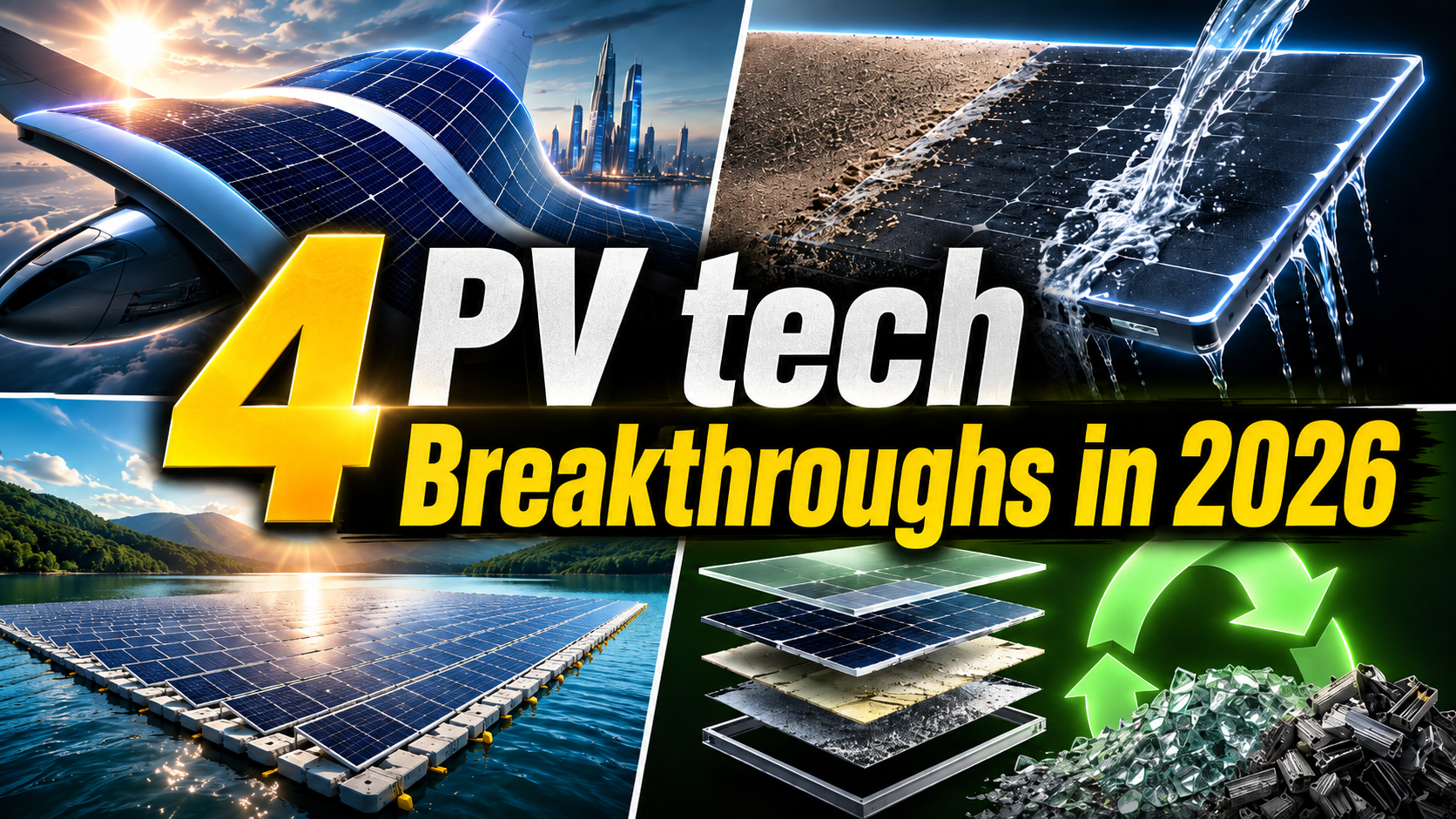
Solar power development in 2026 is not simply about chasing ever-higher conversion efficiency. Some of the most interesting advances are focused on making solar panels lighter, cleaner, cooler and easier to recycle.
These improvements could expand where solar power can be used while also reducing maintenance costs and improving sustainability.
Here are four solar photovoltaic technologies that could help shape the next stage of the industry.
1. Flexible Perovskite-Silicon Tandem Solar Cells
Flexible solar panels have traditionally involved a major compromise. They are lightweight and bendable, but their efficiency has generally been lower than conventional rigid silicon panels.
That gap is now beginning to close.
Researchers have demonstrated flexible perovskite-silicon tandem solar cells with efficiencies exceeding 30%.
The key is the tandem structure.
Instead of relying on one material to absorb the entire solar spectrum, two different photovoltaic materials work together. A thin perovskite layer absorbs higher-energy wavelengths of sunlight, while the silicon layer underneath captures lower-energy light that passes through.
Effectively, the workload is divided between two solar cells.
This allows tandem cells to extract more energy from sunlight while retaining the lightweight and potentially flexible characteristics of the underlying structure.
Why flexible solar matters
Conventional solar modules are relatively heavy because they typically use rigid glass and aluminium frames.
Flexible tandem cells could potentially be integrated into surfaces where conventional modules would be impractical.
Possible applications include:
- Curved building surfaces
- Vehicle roofs
- Aircraft wings
- Drones
- Portable power systems
- Lightweight structures
For electric aviation in particular, extremely lightweight solar cells could eventually become attractive for long-endurance aircraft and unmanned aerial vehicles.
However, there is still a considerable gap between laboratory demonstrations and large-scale commercial modules.
The next challenge will be producing large flexible panels that remain affordable while surviving years of exposure to heat, moisture, ultraviolet radiation and repeated mechanical bending.
2. Edgeless and Anti-Dust Solar Panels
Dust accumulation is one of the less obvious causes of energy loss in photovoltaic systems.
Most conventional solar panels contain an aluminium frame that rises slightly above the glass surface.
The frame provides mechanical strength and protects the module, but it also creates a small lip around the edge of the panel.
When rainwater runs across the surface, some of the water can collect along the lower edge.
As the water evaporates, it leaves behind dust, mud and mineral deposits. Over time, this can create a dirty strip across the bottom of the panel.
This matters because photovoltaic cells inside a module are electrically connected together. Even relatively small areas of shading can reduce the power output of a much larger section of the panel.
One increasingly simple solution is the edgeless or anti-dust solar panel.
These modules remove or reduce the raised border along the front surface.
Without the lip, rainwater can flow off the panel more easily while carrying loose dust with it.
Some manufacturers are also combining this approach with hydrophobic glass coatings. These surfaces encourage water droplets to move across the panel rather than remaining in place.
The idea is mechanically simple, but the benefits could be significant.
In dusty environments, edgeless modules could potentially:
- Reduce cleaning frequency
- Limit dust accumulation
- Reduce shading losses
- Lower maintenance costs
- Improve long-term electricity production
For large solar farms in dry regions, even small reductions in cleaning requirements could have considerable economic value.
3. Floating Solar for Cooler Panels and Better Land Use
Solar panels need sunlight, but they do not necessarily like heat.
This can appear counterintuitive because solar farms are often associated with hot and sunny environments.
However, photovoltaic cells respond primarily to light rather than temperature.
As the temperature of a silicon solar cell rises, its voltage falls. A typical silicon module may lose roughly 0.4% of its power output for every degree Celsius above its rated test temperature, although the exact value varies between panels.
One solution is to move solar panels onto water.
How floating solar works
Floating photovoltaic systems install conventional or specially designed solar modules on buoyant structures positioned on:
- Reservoirs
- Lakes
- Quarry ponds
- Water-treatment facilities
- Hydroelectric reservoirs
The environment above the water can help keep the solar modules cooler, particularly in hot climates.
Lower operating temperatures can improve electricity production, although the actual benefit depends heavily on local weather conditions, wind speed, humidity and system design.
Cooling is not the only advantage.
Floating solar also reduces the amount of land required for energy production.
This can be particularly valuable in densely populated countries where suitable land is expensive or needed for agriculture, housing or industry.
Hydroelectric reservoirs may be especially attractive because electrical infrastructure such as substations and grid connections is often already available nearby.
There can also be benefits for the reservoir itself.
By shading part of the water surface, floating solar installations may reduce evaporation. In certain conditions, reduced sunlight reaching the water could also limit algae growth.
Floating solar therefore has the potential to combine electricity generation with more efficient use of both land and water resources.
4. New Technologies for Recycling Solar Panels
Solar energy is generally considered a clean technology, but millions of photovoltaic modules will eventually reach the end of their operational lives.
That creates a growing recycling challenge.
Existing recycling processes can relatively easily recover components such as the aluminium frame and much of the glass.
Recovering the silicon cells and valuable metals inside the module is more difficult.
One major obstacle is the EVA encapsulant, or ethylene-vinyl acetate.
During manufacturing, EVA is used to bond the different layers of the solar module together and protect the photovoltaic cells from moisture and physical damage.
Unfortunately, that same strong bond makes modules difficult to separate when they reach the recycling stage.
Laser-based solar panel recycling
A study published in 2026 demonstrated a laser-based process designed to separate silicon solar cells from the EVA layer in glass-glass photovoltaic modules.
The laser weakens or breaks the bond between the layers, potentially allowing the silicon cells to be removed more cleanly.
This could make it easier to recover valuable materials or even reuse some components.
If technologies like this can be commercialised, old solar modules could become a valuable source of silicon, silver, aluminium, glass and other materials rather than simply becoming waste.
Perovskite solar cells could be easier to recycle
Emerging perovskite photovoltaic technology may offer another advantage: recyclability.
Researchers have demonstrated water-based recycling processes capable of recovering around 99% of the perovskite material, together with components such as glass and electrodes.
The recovered materials have then been used to manufacture new solar cells with comparable performance.
This points towards a much more circular manufacturing model.
Instead of continuously extracting new raw materials, future solar manufacturers could potentially recover a large proportion of the materials contained in retired modules and feed them back into production.
Solar Innovation Is Moving Beyond Efficiency
The solar industry has spent decades pushing photovoltaic efficiency higher, and that work will continue.
But the next generation of solar technology may be defined just as much by improvements outside the solar cell itself.
Flexible tandem cells could allow solar power to be integrated into aircraft, vehicles and curved structures.
Edgeless modules could reduce one of the most persistent maintenance problems faced by solar farms.
Floating photovoltaic systems could generate electricity without consuming valuable land while potentially improving panel performance.
And advanced recycling technologies could turn millions of ageing solar modules into a valuable source of raw materials.
Together, these developments show how solar power is evolving from a relatively simple electricity-generation technology into a much broader engineering ecosystem.
The question is no longer simply how efficient can a solar panel become?
It is increasingly about where we can put it, how easily we can maintain it, how long it can operate and what happens to it at the end of its life.