
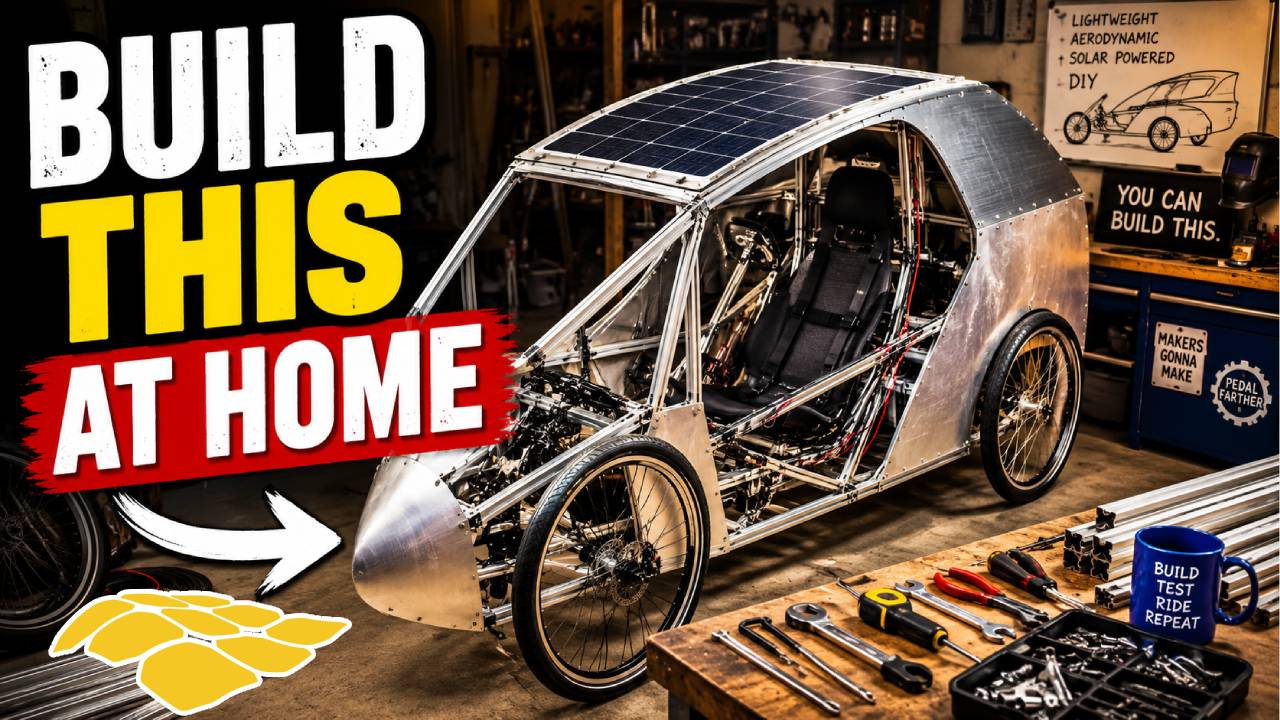
Imagine a vehicle that gives you the health benefits of a bicycle, protects you from bad weather like a small car, and, in many places, may not require gas, insurance, or registration if it meets local e-bike or bicycle regulations.
That vehicle is called a velomobile.
A velomobile is essentially a three-wheeled recumbent bicycle enclosed inside a lightweight, weatherproof shell. It combines the efficiency of a bicycle with some of the comfort and protection of a car. While velomobiles are still uncommon in many parts of the world, they are more popular in parts of Europe, where cycling infrastructure makes them more practical for everyday transport.
For people who need an affordable way to commute, shop, or run local errands, a velomobile could be a serious alternative to car ownership.
Why Velomobiles Make Sense
Traditional bicycles are cheap and efficient, but they have one major downside: they expose the rider to rain, wind, and cold weather. Cars solve that problem, but they come with fuel costs, insurance, registration, repairs, and maintenance.
A velomobile sits somewhere in the middle. It can keep you dry in bad weather, let you use bike lanes where legal, and provide enough storage for small shopping trips or daily errands.
The idea is becoming more relevant as small electric vehicles improve. Solar-assisted cargo trikes, e-bikes, and compact electric vehicles show that not every journey needs a full-sized car. For many short local trips, a lightweight electric vehicle may be enough.
The Big Problem: Factory Velomobiles Are Expensive
The biggest issue with velomobiles is the price.
Many factory-built velomobiles are made from carbon fiber or fiberglass and are produced in small numbers. As a result, they can cost anywhere from $6,000 to $12,000 or more.
That price creates a problem. A vehicle that should be a practical, low-cost transport solution ends up becoming an expensive product for a small niche audience.
For someone trying to save money, spending thousands of dollars on a velomobile may seem unrealistic, especially when a cheap used car can sometimes be bought for less upfront.
But the used car has a hidden problem: ongoing costs.
The Used Car Trap
A cheap used car may look affordable at first, but the total cost of ownership can be much higher than the purchase price.
Fuel, insurance, registration, repairs, servicing, tires, and unexpected breakdowns can quickly turn a cheap car into a financial burden. Over several years, a low-cost used car can end up costing thousands more than expected.
A factory-built velomobile is cheap to run but expensive to buy. A used car is often cheaper to buy but expensive to keep running.
That creates an opportunity for a third option: a DIY solar-assisted velomobile.
A DIY Solar Velomobile Concept
The idea is to build a small, weatherproof, solar-assisted velomobile at home using affordable materials and simple construction methods.
A practical design could be around 80 centimeters wide, 300 centimeters long, and 120 centimeters tall. With careful planning, that size could potentially fit two adults in a compact layout, with limited storage space at the rear for groceries or small cargo.
The vehicle would be narrow enough for many bike lanes, compact enough for urban use, and stable enough for daily errands if the steering, braking, weight distribution, and center of gravity are designed properly.
A solar roof would not eliminate charging in every climate or season, but it could help extend range and reduce charging needs, especially in sunny conditions.
Building Without Welding
One of the most appealing parts of this concept is that it does not necessarily require welding.
Instead of a custom welded steel frame, the chassis could be made using square aluminum tubing or aluminum extrusions. Aluminum extrusions are especially useful because they can be joined with simple fasteners, brackets, and connectors.
These parts allow for straight, angled, perpendicular, and even pivot joints. That makes the build more approachable for DIY makers who have basic tools but do not have access to welding equipment.
AI design tools can also help plan the layout, frame structure, material list, and assembly approach before anything is built.
Low-Cost Body Materials
The body shell could be made from affordable materials such as Coroplast, the lightweight plastic material commonly used for outdoor signs. Coroplast is cheap, easy to cut, and light enough for a pedal-assisted vehicle.
However, durability matters. Any DIY body material would need to be tested for weather resistance, UV exposure, strength, vibration, and long-term wear.
Transparent Perspex sheets that maintain good visibility over time can also cost around $10 per square meter, making them a possible option for windows or canopy sections.
For a prototype, low-cost plastic sheeting may be enough. For a long-term vehicle, the canopy would need proper visibility, scratch resistance, weather sealing, and strength.
Rough Cost Breakdown
A DIY solar velomobile could be built for far less than a factory-made model, depending on local prices and how many parts are salvaged.
A rough parts estimate might look like this:
| Component | Estimated Cost |
|---|---|
| Aluminum frame materials | $400 |
| Electric motor kit and battery | $800 |
| Coroplast or body panels | $250 |
| Flexible solar panels | $300 |
| Brakes, lights, mirrors, wiring, and safety parts | $150+ |
| Wheels and tires | $350 |
| Estimated total | Around $2,250 |
This should be treated as a starting estimate, not a guaranteed final price. The real cost will depend on tools, fasteners, steering components, suspension choices, waterproofing, battery protection, and local availability of parts.
Using salvaged bicycle parts such as wheels, tires, handlebars, brakes, seats, and cables could reduce the cost even further.
Could It Really Replace a Car?
A DIY solar velomobile will not replace a car for every journey.
It is not ideal for motorway travel, long-distance driving, carrying a full family, or driving in every weather condition. It also does not offer the crash protection of a car.
But for short local trips, commuting, school runs, grocery shopping, and daily errands, it could replace many of the journeys people currently use cars for.
That is where the savings become interesting. A used car may cost thousands of dollars over five years in fuel, insurance, registration, maintenance, and repairs. A DIY velomobile uses far less energy, requires simpler maintenance, and may avoid some car-related costs if it legally qualifies as an e-bike or bicycle.
Safety and Legal Considerations
Safety has to come first.
A homemade electric velomobile needs proper brakes, lights, reflectors, mirrors, strong steering, stable handling, good visibility, battery protection, weatherproof wiring, and a low center of gravity.
It also needs to comply with local laws. Motor power, top speed, width, weight, lighting, passenger capacity, and road access rules vary by country and region. A 1,000-watt motor, for example, may not qualify as a legal e-bike in some places.
Before building or riding a vehicle like this, the design must be checked against local e-bike, bicycle, or low-speed vehicle regulations.
The Future of Affordable Clean Transport
The DIY solar velomobile is not a magic solution, and it is not a simple weekend project for everyone. It requires planning, careful design, and a serious focus on safety.
But the idea is powerful.
For roughly the price of a couple of smartphones, it may be possible to build a small, weatherproof, solar-assisted vehicle that can carry one or two people, handle local errands, and dramatically reduce the cost of getting around.
You do not need to be rich to own clean transportation.
With smart design, affordable materials, and careful construction, a DIY solar velomobile could become a practical car alternative for short local trips at a fraction of the cost of car ownership.