
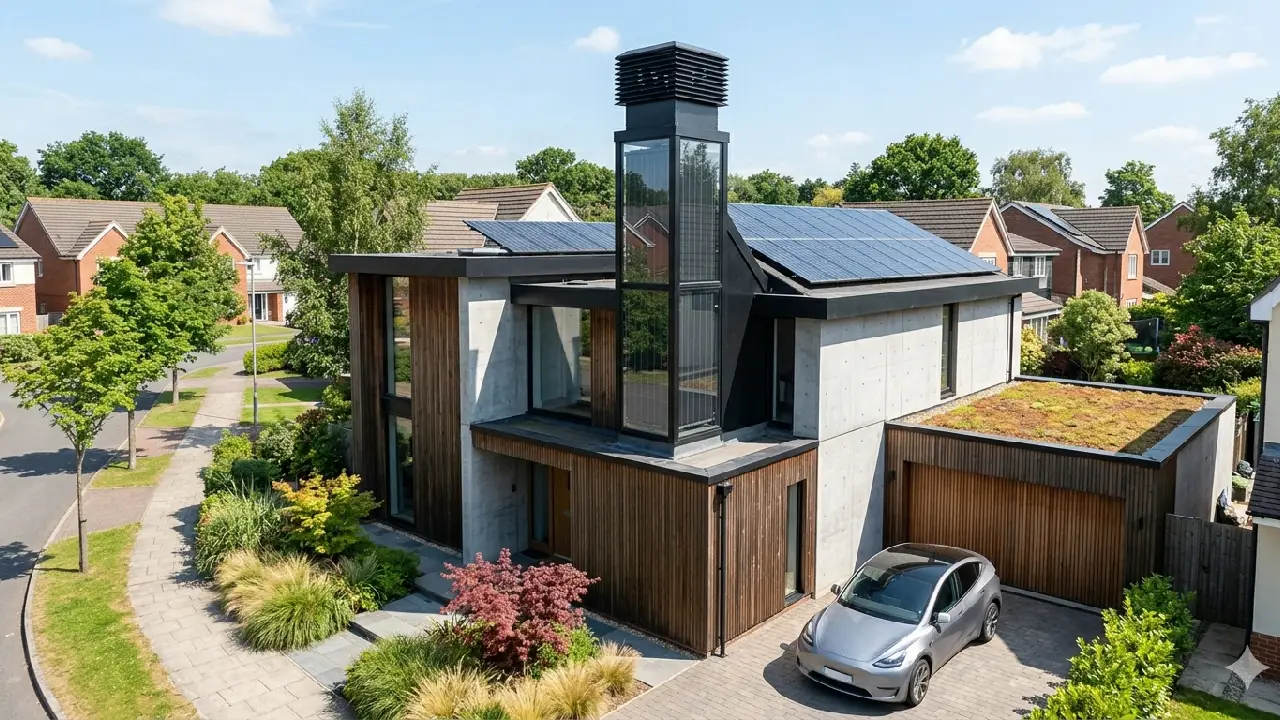
Imagine reducing your heating and cooling costs by up to 30%—without expensive systems, constant maintenance, or increased energy use. It may sound ambitious, but a simple, time-tested concept powered entirely by the sun is making it possible: the solar chimney.
A Modern Take on Ancient Cooling Wisdom
For centuries, architecture has adapted to climate. Traditional systems like wind catchers—widely used across the Middle East—have long helped buildings stay cool by capturing and directing airflow.
Solar chimneys build on this idea but take it a step further. Instead of relying on wind, they depend solely on sunlight, making them more reliable in a wide range of environments.
What Is a Solar Chimney and How Does It Work?
At its core, a solar chimney is a vertical shaft attached to a building, typically positioned to face the equator for maximum sunlight exposure.
Here’s how it functions:
- The chimney is usually covered with glass and contains a dark (often black-painted) internal wall.
- Sunlight passes through the glass and heats the wall.
- The wall absorbs and retains heat, warming the surrounding air.
- As the air heats up, it becomes lighter and rises through the chimney.
This rising air creates a natural airflow that can be used for both heating and cooling—without any mechanical systems.
Heating Mode: Trapping Warmth in Cold Weather
During colder months, the system is adjusted to retain heat:
- A top vent (or baffle) is closed.
- Warm air is trapped and redirected back into the building.
- The result is passive heating—no radiators, no electricity, no fuel.
Cooling Mode: Natural Ventilation Without AC
In warmer conditions, the system flips:
- The baffle is opened.
- Hot air escapes through the chimney.
- This creates a suction effect, pulling fresh air into the building.
But here’s where it gets clever.
Instead of bringing in hot outside air, the incoming air is routed through underground pipes.
The Power of the Earth: Passive Cooling Underground
A few meters below the surface, temperatures remain relatively stable and significantly cooler than above ground.
- In extreme climates where surface temperatures reach 50°C
- Underground temperatures at around 3 meters deep may stay near 32°C
As air travels through these buried pipes, it cools naturally before entering the building. This creates an energy-free air conditioning effect.
This approach has huge potential in hot regions such as:
- The Middle East
- Southern Europe (e.g., Spain)
- North Africa
- Parts of the United States (like Texas)
- Mexico and beyond
Proven Results in Real Buildings
This isn’t just theory.
The UK’s Building Research Establishment (BRE) has successfully implemented solar chimneys in office buildings. Their findings showed:
- Improved natural ventilation
- Reduced reliance on mechanical systems
- Lower overall energy costs
When combined with smart architectural features—like curved roofs that enhance airflow—the system becomes even more effective.
When Underground Cooling Isn’t Practical
If digging underground isn’t feasible, there’s an alternative: the passive downdraft cooling tower.
This system uses evaporative cooling:
- Water cools incoming air
- The cooled air becomes denser
- It flows downward into the building
While different in method, the goal is the same—cooling spaces naturally without heavy energy use.
Solar Chimneys in Modern Sustainable Design
Today, solar chimneys are gaining traction in sustainable architecture. They are being used in:
- Off-grid homes like Earthships
- Research-driven buildings such as Harvard’s Center for Green Buildings and Cities
When integrated with other passive design strategies, they can significantly reduce indoor temperatures without conventional air conditioning.
Complementary Technologies: Chilled Beams
Another emerging solution is chilled beam technology:
- Cool water circulates through ceiling-mounted pipes
- Heat is gently absorbed from the room
- The system operates quietly and efficiently
While chilled beams can reduce energy use by around 30%, they require upfront planning and investment—unlike the simplicity of solar chimneys.
A Smarter Way Forward
As energy costs rise and sustainability becomes more urgent, solutions like solar chimneys are becoming increasingly relevant.
They remind us that innovation doesn’t always mean adding complexity. Sometimes, the smartest solutions come from working with nature—using the sun, air, and earth to create comfortable living spaces with minimal impact.
In a world searching for cleaner, cheaper energy solutions, the solar chimney stands out as a powerful example of simplicity done right.