
For decades, wind power has been one of the cornerstones of renewable energy. Massive turbines dominate landscapes across the world, generating clean electricity at impressive scales. But when engineers attempt to shrink these machines down for farms, homes, and rural communities, a persistent problem emerges: efficiency drops dramatically. Smaller wind turbines simply don’t perform as well as their towering counterparts.
Part of the explanation is straightforward. Wind speeds are generally lower closer to the ground, where small turbines operate. Less wind means less energy. Yet this doesn’t fully explain the issue. Even in locations with usable wind, small turbines often struggle to convert that energy efficiently. This raises an important question: is the problem really the wind—or is it the design?
Rethinking the Problem from the Ground Up
One Japanese company decided that downsizing traditional wind turbine designs wasn’t the right solution. Instead of shrinking old ideas, they chose to rethink small-scale wind power entirely. That company is RIAMWIND, a technology firm focused on creating smarter, quieter, and more efficient wind turbines specifically designed for smaller applications.
Their breakthrough came from a simple but powerful insight: improving how wind flows through a turbine could matter more than increasing blade size or height. This idea led to the development of a unique structural feature known as the wind lens—a design choice that fundamentally changes how the turbine interacts with the wind.
What Is a Wind Lens?
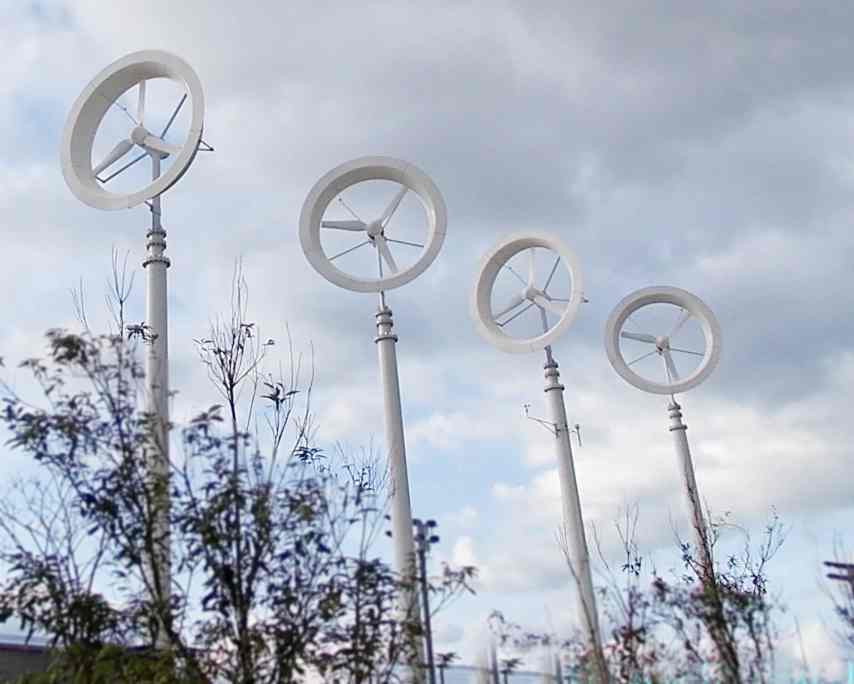
At first glance, a wind lens turbine looks very different from a conventional wind turbine. Instead of exposed blades spinning freely in the open air, the blades are surrounded by a circular shroud, or lens. This structure acts much like a funnel for wind.
As air passes through the lens, it accelerates before reaching the turbine blades. At the same time, the shape of the lens creates a low-pressure zone behind the turbine. This pressure difference pulls even more air through the system, increasing the volume and speed of wind interacting with the blades.
The result is a dramatic increase in performance. In real-world testing and dedicated experimental setups, RIAMWIND has demonstrated that wind lens turbines can generate two to three times more power than conventional turbines of the same size. This is where the claim of 200% efficiency gains comes from—not by breaking the laws of physics, but by capturing and concentrating wind more effectively.
More Power, Less Noise
One of the most surprising benefits of the wind lens design is noise reduction. Typically, higher power output from a wind turbine comes with increased noise due to turbulence around the blades. However, the wind lens helps stabilize airflow, reducing the chaotic air patterns that generate aerodynamic noise.
As a result, RIAMWIND turbines are noticeably quieter than traditional small wind turbines. This makes them far more suitable for use near homes, farms, and rural communities where noise is a major concern. In many cases, quieter operation can be just as important as efficiency when it comes to real-world adoption.
Environmental Benefits Beyond Energy
The wind lens design also offers environmental advantages. Bird collisions have long been a concern with conventional wind turbines, particularly those with fast-spinning, hard-to-see blades. The highly visible lens structure makes the turbine easier for birds to detect and avoid, helping to reduce collision risks.
This combination of increased efficiency, lower noise, and improved wildlife safety makes wind lens turbines a rare example of a technology that improves performance while also reducing environmental impact.
Designed for Real-World Conditions
RIAMWIND’s innovation goes beyond hardware. The company also uses advanced wind-analysis software to model airflow patterns and identify optimal installation locations. By carefully selecting where each turbine is placed, they ensure maximum performance—even in areas with inconsistent or lower wind speeds.
This systems-level approach recognizes an important truth about renewable energy: technology alone isn’t enough. Smart placement and data-driven planning are essential to unlocking the full potential of wind power.
The Limits of Scaling Up
Despite their impressive performance, wind lens turbines do have limitations. The design does not scale well to massive, utility-scale turbines. Instead, it excels in small to medium-scale applications. RIAMWIND’s product lineup ranges from compact 1 kW turbines for individual users to multi-lens systems that combine several turbines into a single structure, reaching up to 15 kW.
Rather than competing with giant wind farms, these turbines fill a different niche—one focused on localized, distributed energy generation.
Built for Safety and Reliability
Manufactured in Japan, RIAMWIND turbines are built to meet strict engineering and safety standards. They include automatic shutdown systems that activate during extreme weather conditions, protecting both the turbine and its surroundings. When wind speeds become dangerous, the system responds automatically, ensuring long-term reliability and safety.
A Smarter Path Forward
The idea behind wind lens turbines is simple but powerful: generate more energy from less wind, reduce noise, and work in harmony with the environment. While they may not replace large wind farms, these turbines offer a compelling solution for farmers, rural communities, and small-scale energy users around the world.
As renewable energy continues to evolve, innovations like the wind lens remind us that progress doesn’t always come from making things bigger. Sometimes, the future lies in smarter design, better understanding of physics, and solutions tailored to real-world needs.